
A short entry here. I am proud to say that my latest blog post features me on SFF WORLD, a rocking blog that often hosts wonderful writers.
Here, I talk about my process. I am proud of this one!
A short entry here. I am proud to say that my latest blog post features me on SFF WORLD, a rocking blog that often hosts wonderful writers.
Here, I talk about my process. I am proud of this one!
Vito is a fellow professor at Delaware County Community College, a friend, and a phenomenal writer. His comments here concerning literary versus genre fiction are enlightening, though I might add that many pieces of classic “literary fiction” were originally meant to be pieces of marketable genre fiction. Possibly we call it “literary” today because language changes so much over time.
I might also claim that literary fiction does not always necessarily deal with the ordinary. Though subtlety, theme, and word-craft might be more of the focus in a piece of literary fiction, it still has a plot (unless a slice of life vignette, and even those follow most of the staples of plot if they are going to be read).
If I might at this juncture, I would claim that I am one of those unfortunate oddballs who sort of does both. I write genre fiction with extra attention paid to line craft and diction. My “genre” friends call me “The Professor” because I am so focused on grammatical and syntactical principles (even when I bend and break them), and my “literary” friends (often fellow professors…not Vito…he has been a pillar of support since I have had the pleasure…) see me as incredibly rough around the edges, a plot hound who writes gratuitous violence and “shock-symmetry.”
And by the way…Vito’s stories are absolutely gripping, so don’t let him fool you when he claims that some literary fiction depends too much upon describing the light creeping under the door or the quality of the manufacture of the curtains.
Either way, whether “genre” is on one side of the ring and “literary” stands leering at the other, I believe the theme here brought to the forefront by Professor Vito Gulla is to tell a good story! Damn it!
So Vito Gulla, pick out a plot, put up a marker, and etch something into the stone!
Vito Gulla
A Club That Would Have Me for a Member
Michael asked me to contribute to his blog a few months ago, and as a twenty-seven year old punk who has dreams of joining the great literary pantheon, I didn’t know that I was the best person to ask. Michael writes horror and writes it well, and I write something his audience, at least from a synopsis, wouldn’t be too interested in.
I write what they call literary fiction, a term that’s as redundant as can be, and I’m probably the kind of guy that most genre writers think is too pretentious and ambitious for his own good. But I’m also the guy who has little time for intellectuals who are thrilled by the sound of their own verbal flatulence. Every time I read something out of the little magazines, those bigname, hardly read university-funded literary journals, I have the urge to burn the pages and stab out my eyes.
I prefer to think that I just write fiction, but I know that everything these days has to be divided and sub-divided to fit neatly on the shelf. But literary fiction, as far as genres go, doesn’t really have a set of conventions to follow. In fact, it could be a western or a space opera, a drama or a comedy, a mystery or a thriller. So really, what separates it from anything else? And there’s only one thing people ever say: the prose.
But to me, that’s a pretty poor reason to lump together such disparate texts. I would even say, that good prose should be a given. I don’t give a damn what you write: You should always aim to write beautifully. It’s the reason a lot of us get into the game in the first place. It’s the euphony of one word eliding into another. It’s using the rhetorical device that best captures your intention. It’s finding “le mot juste.”
At least, it is to me.
But there’s one more way to describe literary fiction: boring. Literary fiction, in most cases, isn’t about the extraordinary. It’s about the ordinary, the things we do everyday, the small,
quiet spaces we share with one another–but I don’t think it needs to be be boring either. The reason why people thumb their nose at the “genre” is because literary writers tend to be too busy describing the light that creeps through the doorway to tell a story.
Literary writers, especially those who almost wholly consume the works of Faulkner and Woolf and Joyce and the like, fail to notice that though the masters have beautiful prose, they understood structure too. Ulysses, a novel that is trendy to hate anymore, isn’t plotless or boring. Joyce takes the ordinary and makes it extraordinary. (Using Homer’s structure doesn’t hurt either.) Every turn has an obstacle, a conflict, a problem. Even when the book is at its most experimental and difficult, there’s a story there. Molly Bloom’s soliloquy has more conflict and beauty on one page than many literary novels have from cover to cover.
And of course, Ulysses is not alone. Novels like The Great Gatsby or The Sun Also Rises or The Crying of Lot 49 or Love in The Time of Cholera or Song of Solomon all have plots and follow the typical three-act structure. Sure, some of these may deviate from our expectations in places, but overall, these stories are still stories. And they’re never once boring.
But anymore, that seems to be the exception rather than the rule in literary fiction. For every Murakami or Cormac McCarthy or Junot Diaz or Philip Roth, there seems to be one hundred other writers who only know how to describe. That’s very discouraging as a reader.
On the flip side, there’s genre fiction, and the thing about reading genre fiction is that it’s often all the same. If you walked into a bookstore and picked up two out of the many thrillers on display, you would probably see, just from the cover, a similar picture on the front and a description of a story that would be completely interchangeable between them. Rough and tumble hero Jack or John fights corruption/conspiracy–will he survive? And very rarely are the characters or plot all that different once you open it up. But worst of all is the prose.
Many writers of genre fiction seem careless in their diction choices. Sentences are not crafted and considered but slapped out on the keyboard in order to reveal the story (though in many cases that too is sadly just as hackneyed and trite). Look at a writer like Stephanie Meyer.
Her prose is staler than day old bread and lacks any depth or nuance. Furthermore, her use of punctuation is just as lazy. It’s hard not to pass through a page without finding a plethora of dash ems, a mark reserved for emphasis, but if every sentence requires emphasis, then that effect becomes numbing and needless, no longer serving a purpose. And frankly, her tale of choosing supernatural boyfriends isn’t all that thrilling or empowering either.
So what’s a writer to do?
If you love both beauty and story, it seems like you’re fucked. As I said already, we have a few that carry on the tradition in the literary world (and those that do so in genre like Raymond Chandler or Richard Matheson), but it’s something that has been bothering me for sometime now. These distinctions, these categories that we make up are largely arbitrary. I don’t really care what a story is about anymore: I care that it’s well-crafted and meaningful. But we use these categories to define what the text should be rather than what it can be.
It’s dangerous for any art to be so far up its own ass. MFAs come out of their programs and criticize genre writers because they can’t write a clean and proper sentence, but those same MFAs don’t recognize that they themselves are often clueless how to create a plot. They think order and structure limits their freedom. (It doesn’t.) Just because you’re writing about ordinary people living ordinary lives doesn’t mean your story need be aimless. And we have the genre
writers, who say turn off your brain and enjoy the ride, but don’t recognize that’s fucking stupid. Half the fun is giving the text the courtesy of an analysis, exploring its potential meaning. It’s the
reason we come back to it.
If there’s one thing I can recommend to the writer of any genre, read outside yourself, pick up a book and learn from it. Who gives a shit that the story appeals to you. I’m not fond of love stories or horror, but that’s because a lot of those novels decide to do the same thing that everyone else is doing. Yet, I’ll still pick one up. Stephen King, a writer of good prose and probably the most prolific and talented writer of horror ever, in On Writing, explains that we learn from both the bad and the good. Bad books teach us what not to do; good books teach us what to aspire to do. And if you look at King’s reading list from that year you’ll notice he doesn’t solely read ghost and monster stories. There’s a hell of a lot of Faulkner too.
So don’t aim to be one thing: Be what you need to be at that moment to tell the best story you can. Let the marketing people worry about where you fit on the shelf.
Check out my guest blog post on Midnyte Reader! Here, I talk about the way I come up with plot and character. At this point I am the third entry down, so you will have to scroll a bit.
My novel in progress – ‘Dead Red’ is about to cross page 100 at 31,000 words. My end goal is 90,000 words minimum, and I would project finishing the rough draft by Christmas. I feel that will be good timing, because my third (and best) novel titled ‘Phantom Effect’ will come out February 2016 through Night Shade Books.
I just read ‘Joyland’ by Stephen King, and I enjoyed it. King has always had the ability to find a character’s center quickly and effectively, but with this one it was clear how effortlessly and selflessly he transfers details of story and movement. I personally get quite caught up in descriptions when I am writing, often making them “artistic” and “showy.” King somehow puts you in a summer carnival and with subtlety and pinpoint accuracy, involves you there without making you stop and say “what brilliant descriptions.”
King is the prodigy of our time. I consider myself quite lucky to have his material to enjoy and learn from.
I write young adult fiction under the name of Nicholas Fisher. My first young adult novel titled ‘Becky’s Kiss’ will be coming out in November through Vinspire Press, Editor: Dawn Carrington.
It was fun writing this piece, and many of my close friends asked why I chose to walk away from the hard core adult horror I was most comfortable with. My answer is that I do not specifically write “horror” in the first place, as I feel it is more a “spice” than a genre. And plainly, the idea for ‘Becky’s Kiss’ seemed interesting. It mixed mystery, romance, and baseball, and what could be better than that?
I will say that as I have worked deeper into this business, I have found that the advice one gets is ultimately important…good advice, things you can use as opposed to someone’s harsh criticisms that simply poke holes. In other words, it is too often we lend out our stuff and have someone rip it apart, clearly developing their own critical voice(s). I suppose part of the growth process is taking the criticism you can utilize positively and utilizing it! Discard the rest (sorry Mom). There is only heartache there.
In terms of ‘Becky’s Kiss,’ I was fortunate enough to have gained a plethora of ideas from people above me in the business in terms of level of success and experience. I re-wrote this piece many times, gaining wonderful and highly valued advice from Tamara Thorne (horror author), Meghan Macdonald (my agent at the time), Claire Evans (Editor at Dial / Penguin’s Young Adult Division), Q.L. Pearce (successful children’s author), S.T. Joshi (Lovecraft’s number 1 World Biographer), and Cherry Weiner (literary agent – possibly the most active for successful horror writers nowadays). In the end, I think I came out with one hell of a book.
I made a separate website for ‘Becky’s Kiss’ and any future young adult material to be written by Nicholas Fisher. I thought it would be appropriate to provide the link here.
http://nicholasfisherbooks.weebly.com/
I enjoyed this podcast interview I had the opportunity to give on Castle of Horror. Check it out! Scroll down and I am the 4th or so on the list, 5/12/15. Here I talked about horror fiction in general and some neat behind the scenes stuff for ‘The Witch of the Wood.”
http://castledraculapodcast.com/
Check out my latest short story on The Turks Head Review!
http://turksheadreview.tumblr.com/post/120120379361/tornados-and-os
My Note: I have known Dr. Annalisa Castaldo for just short of twenty years now. I was lucky enough to get assigned to her Introduction to Shakespeare class at Temple University in the mid to late nineties. I was well on my way to the first masters degree at Saint Joseph’s University, and they did not have the Shakespeare class I needed to complete my certification to teach secondary public school. I had taken Shakespeare classes before, yet Annalisa’s was different. She had us editing text and changing contexts, creating movie scripts, writing papers that dug deeper than the standard issue symbols and metaphors. The first paper I handed in received a “B.” What? Really? I had not earned anything lower than an “A” on any paper yet in graduate school, and this was at the tail end of the degree. I asked advice, and she told me exactly where she wanted more proof, evidence, and support. The original paper requirement was five pages. I handed in a fifteen page rewrite and got an “A,” the most meaningful grade I received in my graduate studies, only tied possibly with a paper I managed to put together concerning “The Marriage Group” in Chaucer’s ‘The Canterbury Tales’ while attaining my second masters at Villanova.
Annalisa and I became friends and she has remained a mentor figure in my life, truly cherished. Back in 2009 a dream came true for me when I put out my first published collection, and Annalisa gave me the first back cover blurb. A year or so later I had my first job as a professor of English at Widener University, working right down the hall from my official mentor, Annalisa Castaldo.
Thank you, Annalisa, for teaching me so much about life, about scholarship, about art. Pick a plot, put up a marker, and etch something into the stone!
Annalisa Castaldo
Shakespeare, like other early modern playwrights, loves to put the supernatural into his plays. A conservative count has some supernatural element showing up in 13 of his 37 plays and if we include Othello and his possibly magical handkerchief, we can say that over a third of Shakespeare’s plays contain something supernatural. The big and most well-known examples of the supernatural, of course, are the fairies in Midsummer Night’s Dream and the witches in Macbeth.
But what about the ghosts? Aside from the ghost of Hamlet’s father, ghosts receive very little attention, either scholarly or dramatically. I am here to stand up for ghosts as an important—perhaps the most important—element in Shakespeare’s supernatural arsenal, and to argue that ghosts are not the simple harbingers of doom we tend to think.
So to start—which plays of Shakespeare’s actually have ghosts? There are five, or possibly six: Hamlet, Macbeth, Richard III, Julius Caesar, Cymbeline and possibly The Winter’s Tale (I’ll get to The Winter’s Tale in a minute). Shakespeare used ghosts in his plays more than his contemporaries did—it seems Shakespeare liked ghosts!
Caesar’s ghost is the most straightforward. It is actually taken directly from Plutarch and Shakespeare seems to have included the ghost purely because it was in the source, and because he could. The ghost does not add anything to our understanding of Brutus’ character, nor does the supernatural visit seem to influence the outcome of the battle in any way.
In 5.3 of Richard III, the ghosts of all the people Richard has murdered—Prince Edward, King Henry, Clarence, Rivers, Grey, Vaughan, Princes in the tower, Hastings, Lady Anne, and Buckingham—enter as Richard and his opposite Richmond (the future Henry VII) sleep. Each in turn describes their death, curses Richard, saying “despair and die” and then offers blessings and support to Richmond.
What is interesting here is how the ghosts work both as a manifestation of God’s providence—Richard is not a Machiavel in a soulless universe, but the unwitting scourge of God, ready now to be discarded—and a psychological window into Richard’s interior. As much as Richard has shared with the audience, this is the first time we have seen him with his guard down. Awakening in terror, Richard meditates on his bloody path:
My conscience hath a thousand several tongues,
And every tongue brings in a several tale,
And every tale condemns me for a villain….
I shall despair. There is no creature loves me;
And if I die, no soul shall pity me:
Nay, wherefore should they, since that I myself
Find in myself no pity to myself?
A very different use of ghosts comes at the end of Cymbeline: The appearance of the hero’s family has a strong claim for Shakespeare’s most specific stage direction “Enter, as in an apparition Sicilius Leonatus, attired like a warrior, leading in his hand an ancient matron, his wife and Mother to Posthumus, with music before them. Then, after other music, follows the two young Leonati, brothers to Postumus, with wounds as they died in the wars. They circle Posthumus round as he lies sleeping, appealing to Jove to help the last surviving member of the family and their appeals are rewarded when Jove himself descends on an eagle to announce that Posthumus will be saved and rewarded for his bravery.
Banquo seems like a very simple ghost—he unspeaking, merely pointing and, apparently, shaking his blood soaked hair. However, his silence and the fact that no one but Macbeth can see him makes it possible for directors to cut the actor and thus make ambiguous the question of Macbeth’s sanity. Artists and directors have had a great deal of fun representing the ways in which a ghost might appear and disrupt dinner. Banquo actually appears twice; he is part of the procession of kings the witches show Macbeth in 4.1. Despite their warnings to ask for no more knowledge, Macbeth insists on knowing if Banquo’s issue will inherit. He is “rewarded” with “A show of Eight Kings, the last with a glass in his hand; GHOST OF BANQUO following.
And then there is Hamlet. Everything about this play is superlative—longest, most editorially complex, most performed, and so of course the ghost is the most complex. Hamlet Senior shows up 3 separate times, over 4 scenes. He is both visible and invisible. So many questions. Why doesn’t the ghost appear to Hamlet right away, but first to the guards? Why does he even demand revenge if he is actually a soul in purgatory, because if Hamlet kills the king, his uncle, he will be doomed to hell, or at least purgatory? Why does the ghost not appear to Gertrude? Why does the ghost (in common with his son) seem more concerned with the sexual behavior of his wife than the fact that he’s been murdered by his brother? It is here, midway through his career, that Shakespeare creates a ghost who is a full-fledged character, not just a walk on part muttering about vengeance.
Finally, I want to talk mention The Winter’s Tale even though there is no ghost in it, because the ghost of Hermione never appears on stage and in fact, cannot be there since Hermione is not actually dead (as we find out in Act 5). But in Act 3, we and all the characters believe she is dead, and Antigonous gives a powerful description of the apparition he has seen. “Sometimes her head on one side, some another;/I never saw a vessel of like sorrow,/So fill’d and so becoming: in pure white robes” And the prophecy this vision delivers turns out to be true—Antigonous does never see his wife again, because in this very scene he is eaten by a bear, and the ghost’s demand that the baby Perdita be left on the shores of Bohemia leads her to meet, once she has grown up, the prince. They will run off together and thus unwittingly return Perdita to her home in Sicilia and reveal that she is in fact, the missing princess. Shakespeare leaves ambiguous whether this is mere chance or something supernatural guiding the happy ending. Like all of Shakespeare’s ghosts (but more so) Hermione’s ghost functions as a supernatural commentary on the action and a way for audiences to connect to the characters.
Ghosts on Stage
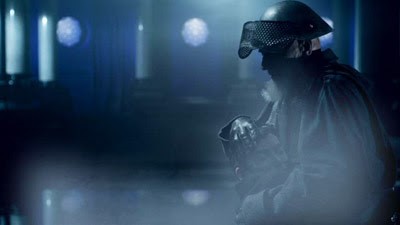

Richard III
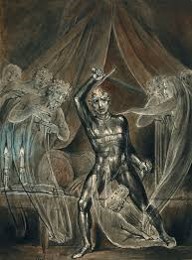
Hamlet Sr. in Hamlet


Banquo in Macbeth

Show of Kings / Macbeth

Ghosts of Julius Caesar
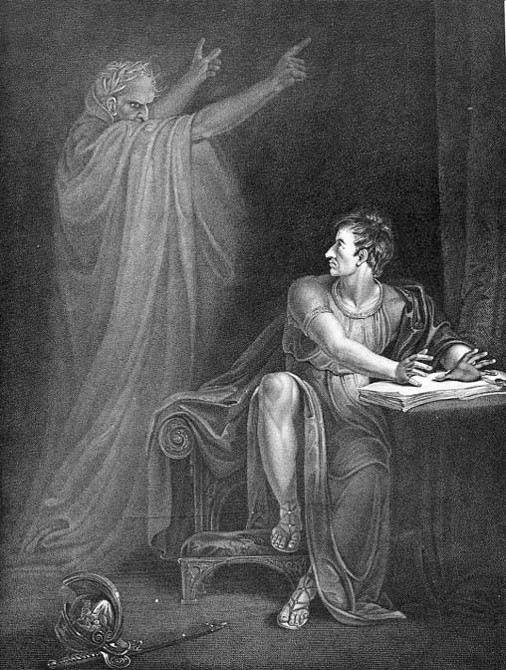
Ghosts of Cymbeline

The Ghost who is not a Ghost – The Winter’s Tale

My Note: I have known Ken Bingham for twenty-three years now and he is one of my dearest friends. He is a Professor at Drexel University, a creative writing instructor for The University of the Arts, a novelist, playwright, theatrical producer, and editor. I brought my first horror story to Ken’s class back in 1992, and I was scared, excited, and passionate, my heart on my sleeve and all that. It was called “The Clever Mask,” and the class hated it. They used words like “gratuitous,” and “graphic” and “overly violent.” I thought I was going to die of pure shame, sitting there, especially because in Ken’s class the author being reviewed was not permitted to speak back. One young woman named Jill then raised her hand and said, “I liked it. The story was primal and in-your-face.” The class erupted. Ken then calmed everyone down and said, “You might not like the content, but this story has power. It will publish, mark my words.”
It did publish, and came out yet again in my first collection. Since then, Ken and I have been the best of friends. His shows are awesome and the dinner parties he throws at his Philadelphia home are epic. He still remains the greatest teacher I know, and the very, very best of the people on this earth.
So Ken, pick out a plot, put up a marker, and etch something into the stone!
Ken Bingham
One of my students wrote me last night, a highly skilled writer who knows how to walk out on a high wire without a net….but only in her flash fiction. Problem is, she told me, she wants to write a novel and just can’t get her head into gear. Every time she starts, she gets about 100 to 200 words in, hates her work, hates her life, and hates writing. And then…stops.
It’s the old Dead Shark symptom that swallows most writers whole, especially those who are afraid of their own ability. Many years ago, when I was still unpublished, I attended a Christmas party with old high school friends. I had confided in one of them that I wanted to be a writer someday. At this time in my confidence, admitting something like this was paramount to telling people that I really thought I was from the planet Ebbon, and that someday I would prove it.
Well, not only did my friend not laugh, but she told a friend of her mom’s who specifically came to the party to meet me. He was a novelist and was working on his first book. My God, my jaw just dropped. To someday be able to even make this claim with such audacity was something I could barely conceive. He even asked me if I’d like to read his work when he was finished.
I thought I’d died and gone to heaven. And just in time for Christmas.
I asked when he thought he might be done and he confidently told me it would be completed by April. Well, April came about and I hadn’t heard from him. May. June. Same story. Finally, in July I made a call, as scared and prepared as if I were calling someone for a date.
Thank God, he remembered me, and told me that he was not as yet finished with the work. I remember his words very well: “I’m not finished with it yet; but I’m working very hard on it. I should be finished it in two months or so.”
That was good enough to get me through the summer. But I didn’t hear in October, nor November. I called in December, a full year after I met the guy, and he once more not only remembered me, but was glad to hear from me. When I asked if he’d completed the book, he simply said, “I’m not finished with it yet; but I’m working very hard on it. I should be finished it in two months or so.”
Again, I waited until April. No call. And this time I didn’t call him. I figured the guy had been lying, that he never intended to give me a read of his book. I was some wet-behind-the-ears kid who he really didn’t have a whole lot of time for, much less want to share his written word. I was pissed he couldn’t have been more honest, but moved on.
I never forgot that book though. He’d told me a good deal of it at that first party. It was called The Dispossessed, and was about an Italian terrorist who fought the war in Sicily, before repatriating to the United States where his past and his loves caught up with him.
Looking for this book became a minor obsession with me. I scoured book stores everywhere. And, before the advent of the internet, I had to employ what were known as bookfinders to see if they could hunt down a copy of this novel. Over the years, several novels by the name of The Dispossessed found their way onto my desk. None of them were his, however.
There was one horror story Exorcist rip off; there was one erotic thriller set in postwar England; there was one about Superheroes who have lost their powers. They were all pretty bad, even the erotica.
Eventually, the book slipped into the back of my mind, as did its potential author.
Now, let’s fast forward a few years. One brisk Fall evening in my 27th year, I was headed to a classroom to teach my first Creative Writing class. I had already published a couple books of my own, had earned a full time teaching career, had started my first theater, and had fallen in love. However, walking to teach this class, this was the time I felt that I had really come of age.
I had reached a stage where I could actually stand in front of people and not only tell them I was a writer, but was confident that I had something to teach them about the craft of fiction. I was nearly coming out of my head.
I had planned the lecture right down to the last detail. I don’t think in all my years now (and there’s been 23 of them since) that I’ve ever prepared for anything more, not my wedding, not any part that I ever played on stage, and certainly not another lecture.
However, as soon as I walked into that room, and stood before the students, everything left me. There, sitting in the front center of the class, was the man whom I had met so many years ago at that party, the man who promised me one day to read his book, the man whom I wanted to become. And here he was, this paradigm of everything I wanted to be, and he was here to learn from ME?!
No fucking way.
I tried to go into my lecture, but all the words left me. I had to stop.
This was a farce. I needed to confront this guy. Something was wrong. My whole world had shifted. I could hear Rod Serling narrating every moment of my existence.
I stopped the class and asked him if he remembered me. I could hear the voice of the kid I’d been asking him the same question on the phone those two times that I had called. And I remembered his gentle voice assuring me like he’d done before that, yes, he did remember me.
Then of course I told him how possessed I’d been with The Dispossessed for a while, how I’d tried to hunt it down, had read several foolish books by the same title; and asked him if he could please bring in a copy the next week of class; I’d gladly pay him for it.
That’s when he told me, without blinking an eye, “I’m not finished with it yet; but I’m working very hard on it. I should be finished it in two months or so.”
Oh, my Dear Mary, Mother of God.
He did assure me that the book would be done by the end of the class. I didn’t believe this at this point, but at least got him to commit to bringing in the first two chapters on the last day.
That class ended up being the only one he didn’t show up to.
We’ve since become dear friends, and I’ve found out the problem. I know his work ethic.
My friend, whom I allow to remain nameless, works harder than any other author I have ever met. He puts in at least four hours a day to his work. And he’s still working on The Dispossessed. It’s been 32 years, and he’s still working on this. Nonetheless, he continues to tell me that “it should be done very soon.”
And he’s an incredible talent. I love his work. It’s insightful, whimsical, full of love and energy. The tapestry of his prose is rich. The lines undulate. They have a rhythm that effects the pace of your heart.
But he will never finish this work.
And here’s the reason why.
After he finishes a paragraph, he goes back over it. He works it and works it and works it and works it and works it and works it and works it and works it and works it and works it and works it and works it and works it and works it and works it and works it and works it and works it and works it and works it and works it and works it and works it and works it and works it and works it and works it and works it and works it and works it and works it and works it and works it and works it and works it and works it and works it and works it and works it and works it and works it and works it and works it and works it and works it and works it and works it and works it and works it until it is the greatest paragraph you have ever read in your fucking life.
However, he’s a good writer and, as any good writer knows, you learn as you go along. So…he has learned things from writing this paragraph, and therefore has to make changes now to the paragraph that came before and he works it and works it and works it and works it and works it and works it and works it and works it and works it and works it and works it and works it until that paragraph is the best paragraph ever written by human hand.
But, the thing is, he’s a good writer and, as any good writer knows, you learn as you go along. So…he has learned things from writing this paragraph, and therefore has to make changes now to the paragraph that came before and he works it and works it and works it and works it and works it and works it and works it and works it and works it and works it and works it and works it until that paragraph is the best paragraph ever written by human hand.
But, the thing is, he’s a good writer….
You get the picture.
He can’t trust his writing. He can’t trust himself to just go on until the end of the draft.
To date, the man is on page 172, but he’ll never finish the work. He’ll have to bequeath this to his children, and I’ll have to bequeath the hunt of this book unto you, O Class, fully expecting you to pass the hunt to your children. Someday, hopefully this book shall actually be completed, and someone, possibly a New type on some ultra-world will get the opportunity to read it.
Don’t Sharks Have No Bite
The Dead Shark theory stems from a Woody Allen movie called “Annie Hall.” If you haven’t seen it, please do so. NOW!
Go ahead. I’ll wait here.
https://www.youtube.com/watch?v=6RFH9_M0OaY
Back?
Good. How’d you like it?
And, if you didn’t bother to click it and are just PRETENDING you did, let me summarize.
Annie and Alvie are flying back from Los Angeles together. They’re both at the very end of their relationship; both know it for a fact; yet neither really has had the courage to tell the other one.
We’ve all been there. I know I have, and I’ve never had the guts to actually do the breaking up. Sadly, my break up of choice is to act like such a jerk that they end up breaking up with me. Yeah, real mature, Ken.
Alvie, however, is a little more courageous than I am. He tells Annie, “You know, a relationship is like a shark. It has to keep moving forward all the time, or else the shark just dies. I think what we have on our hands here is a dead shark.”
And that’s exactly what happens every single time you stop a draft to go back, to look over your work. You kill the shark.
Every time you lose confidence in yourself, every time you doubt your skill, every time you are struck with fear of the unknown that lies ahead of every untyped page, you kill the shark.
I can’t tell you how many times I’ve gone into my friend’s office to find him still working on, you guessed it, The Dispossessed. He’ll ask me to sit down, and cordially invite me to listen to a paragraph he’s just finished. And, what do you know, it’s the fucking first paragraph again.
And it’s better!
But it doesn’t matter. Because he’ll NEVER FINISH IT.
So that’s what I told this writer who contacted me last night. She has to have the courage to simply go on without knowing what’s lying ahead on those unwritten pages. You’ve got to find a way to crush that little editor on your shoulder, the one that questions everything you’re putting on the page.
The rest is simple.
 Michael Aronovitz's Blog